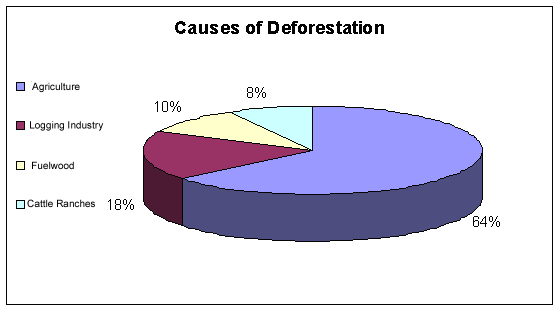
Agriculture, logging, along with development in general, is one of the major CAUSES of deforestation, primarily in the Amazon. While it is not a problem caused by deforestation, it is an issue that had lead to the bigger problem of deforestation, which in turn causes many other problems. 65-70% of the cause of deforestation is from cattle ranching, 20-25% from subsistence farming, 5-10% from commercial farming, 2-3% from both legal and illegal logging, and 1-2% from forest fires, construction of roads and dams, and urbanization. The ones who created this, which lead to deforestation, are humans. People will clear out large chunks of rainforests to plant crops there, and within a few years, the soil will no longer be able to support life. This leads to more forest being cleared out to plant crops elsewhere, and the soil left behind is incapable of regrowing the forests due to the over-use. This benefits the farmers, logging companies, and most of the rest of the world. The crops grown are shipped to our stores, and the trees logged are used to make paper. Us people in first world countries are positively affected by the agriculture and logging, as well as the oil mining, because we receive the products produced from the labor.
One of the mains group who are negatively affected by this aren’t people, but the native species residing within the forest that are being ripped apart. This includes both plants and animals. In the Amazon rainforest, there are over 40,000 plant species, 2.5 million insect species, 205 bird species, along with millions of other animals species. More than half of the 10,000 million species of animals, plants, and insects in the world call the Amazon their home. The forests provides food and shelter for these species, and the removal of the majority of it would result in a decline of the species’ populations, especially those that are already near extinction.

Another group who is negatively affected by deforestation from agriculture and logging is the Amazonian tribes who live within the rainforest alongside the plants and animals. There is thought of be around 400-500 of these tribes, 50 of those have never had contact with the outside world. The tribes mainly thrive by hunting and gathering, as well as minimal farming. They have no rights to the land they reside in, mostly being owned by nearby villages or the government, and therefore they cannot say “no” to those who want their land. In the 1500’s, there was thought to be 6 to 9 million members of Amazonian tribes, but now there seem to be only 250,000 members, with the rapid decline due to deforestation from agriculture, logging, urban development, mining, etc.

However, it is possible to consider that deforestation, caused by mostly agriculture, logging, etc., is not such a bad thing. After all, we here do receive the many beneficial products the rainforest produces. We use paper in some way, shape, or form almost everyday, and all of that comes from the forests we log! There is also a policy in some places, that for every tree chopped down, two more will be planted, which will quickly rebuild the resources we are using. Farming also gives us these wonderful products, such as fruits and vegetables we eat everyday and adore so much. But, evidence shows that the logging and farming do not give as much as they take. When the trees are cut down, mostly using the slash-and-burn method, there is no more organic matter, such as leaves and fallen fruits, to be put back into the soil. This results in soil infertility, and makes it difficult to farm and replant more trees. With it being difficult to farm, within a few years, the farmers will need to find more soil to use for crops, thus needing to cut down even more of the rainforest, and the cycle repeats.
